
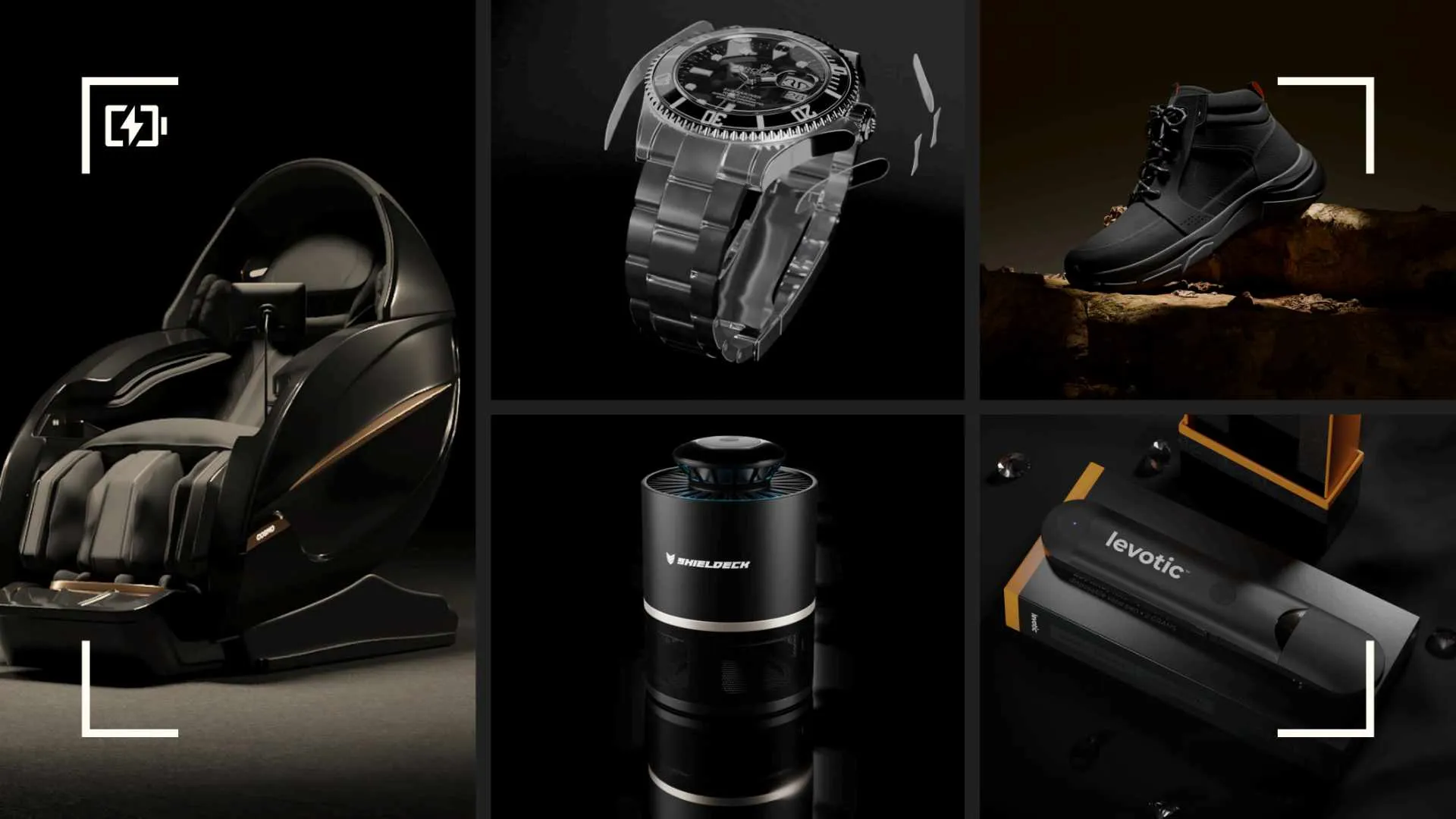
Why We Deliberately Make Renders That Don’t Look Like Renders
If a 3D render looks like a 3D render, we consider it a failure.
That sounds strange coming from a studio that does 3D product animation for a living. But it is the single clearest way to explain what we actually sell. Clients do not come to us because they want computer graphics. They come to us because they want their product to look real, expensive, and photographed by someone who knew exactly what they were doing. The 3D part is just how we get there.
Lately this has become the first thing prospective clients tell us, before budget, before timeline, before anything else. We are hearing the same sentence over and over, phrased a dozen different ways:
“We don’t want it to look AI-generated.”
“We want it to look like real photography, not a CAD render.”
“Customers should believe they are looking at a finished, professionally photographed product, not a model on a screen.”
It is worth unpacking why that request has suddenly gotten so loud, and what actually goes into meeting it.
The “AI look” problem is real, and buyers can smell it
For the past couple of years, anyone with a text prompt has been able to generate a slick-looking product image in seconds. That flood of AI imagery has done something interesting to the market: it has trained ordinary shoppers to recognize fake.
People cannot always explain what is wrong. They just get a faint feeling that an image is off. The reflections do not match the environment. The material looks like a guess at leather rather than actual leather. Proportions drift a little from photo to photo. Edges are too clean, or lighting is too even, or the product floats in a space that does not physically make sense.
For a brand trying to sell a premium product, that faint feeling is poison. A luxury dock system, a designer sofa, a stainless-steel appliance: the entire pitch is “this is worth the money.” The moment the imagery whispers “this is fake,” the pitch collapses. The buyer does not consciously decide the product is cheap. They just move on.
So when a client says “don’t make it look AI,” they are really saying: don’t lose me the sale in the first half-second.
AI images and CAD renders fail for the same underlying reason
It is tempting to lump “AI-looking” and “CAD-looking” together as one problem, but they fail from opposite directions and it helps to see both.
AI images fail because they are not built on anything. There is no real object, no real material, no real light. The model is producing something that resembles the average of a million product photos. It has no idea how thick the steel actually is, how the seam on that cushion is stitched, or how a specific finish scatters light. It approximates, and approximation is exactly what the human eye catches.
Raw CAD renders fail for the opposite reason. They are built on something extremely precise, the engineering geometry, but that geometry was made to manufacture the product, not to sell it. Straight out of the CAD program, a model tends to look sterile: flat plastic-looking materials, hard even lighting, no atmosphere, no sense of place. Accurate, but lifeless. It reads as “technical drawing,” not “hero shot.”
Photography sits between those two failures. A real photographer starts with a real object (total accuracy) and then spends most of their effort on everything that makes it look good: lighting, angle, environment, mood, the way a highlight rolls across a curved surface. Our job is to reproduce that middle ground digitally. Engineering-grade accuracy underneath, photographer-grade craft on top.
What “making it look photographed” actually means
When we say we build renders to pass as photography, here is what that involves in practice. None of it is automatic, and this is the part that separates a convincing image from an obvious one.
Real materials, not material presets. A default “fabric” or “metal” setting will never survive a close-up. We build materials that behave the way the actual thing behaves: how bouclé catches light differently from velvet, how brushed steel throws a soft directional highlight while polished steel throws a sharp one, how water bends and distorts what is behind it. If the real product has a specific finish, the render has to earn that finish.
Lighting that obeys physics. Photographers spend years learning to light a product. We treat digital lighting the same way, using light that behaves like real light, bouncing, softening, casting the kind of shadows a real studio or a real outdoor scene would produce. This is where most amateur renders give themselves away. Even lighting looks fake. Motivated, slightly imperfect lighting looks photographed.
A camera that thinks like a camera. Real lenses have real behavior: depth of field, subtle distortion, focal-length choices that flatter or exaggerate. Matching a client’s reference photography often means matching the lens they shot on, not just the angle. Get this wrong and the product feels like it is sitting in front of the scene rather than inside it.
Consistency across the whole set. This is the quiet one, and it matters enormously for e-commerce. A brand does not need one perfect image; it needs twenty images across colors, configurations, and angles that all look like they came from the same shoot on the same day. AI tools are notoriously bad at this, drifting slightly every generation. A properly built 3D pipeline nails it, because it is the same accurate model lit the same accurate way every time.
A believable environment. A product photographed on a seamless studio background still has to sit convincingly in that space, with correct contact shadows and reflections. A product placed in a lifestyle scene has to belong there. This grounding is often the difference between “nice render” and “wait, is that a photo?”
Why accuracy is not optional, especially before the product exists
There is one more reason we obsess over getting the physical details right, and it goes beyond aesthetics.
A growing share of the work we are asked about involves products that are not manufactured yet. A brand has finalized the design and the CAD files, and they want a full library of hero images, packaging shots, and lifestyle scenes ready before the first unit comes off the line. The render is not a substitute for a photo of the product. For a while, it is the only image of the product that exists.
That raises the stakes on accuracy. If the stainless-steel finish in the render is a shade off, if the proportions drift, if a control or a seam is in the wrong place, the brand ships marketing that does not match what the customer eventually unboxes. So the standard is not just “looks real.” It is “looks real and is a faithful representation of the actual production product.” Those are two different bars, and premium brands need both cleared.
The takeaway
The best compliment our work gets is not “great render.” It is a client’s customer assuming they were looking at a photograph the whole time. That is the entire point.
Making a render that looks like a render is easy. Making one that quietly passes as professional photography, that survives a full-screen close-up, that holds up across an entire product line, and that stays faithful to a product that might not physically exist yet, is the actual craft. It is why real 3D product visualization is not going anywhere, no matter how many one-click image generators show up.
If you have a product, a set of CAD files, or even just a design you want to see rendered to that standard, we would be glad to talk through it.
Related Articles
You Made a Product Image with AI. Here Is Why It Cannot Become Your Product Video.
The Apple Formula: Why Every Tech Startup Wants Their 3D Animation to Look Like Apple (And How It’s Actually Done)
Your Catalog Keeps Growing and Every New Product Means Another Photoshoot. Build the Asset Library Instead
It Is 2026, Apple Puts AI in Every Device, and It Still Launched Its New Hardware With 3D Animation
CGI vs AI for Product Visuals: Key Differences, Cost and When to Use Each (2026)
Product Hero Shots: What They Are, Why Brands Now Render Them in CGI, and What They Cost


 Rachel A